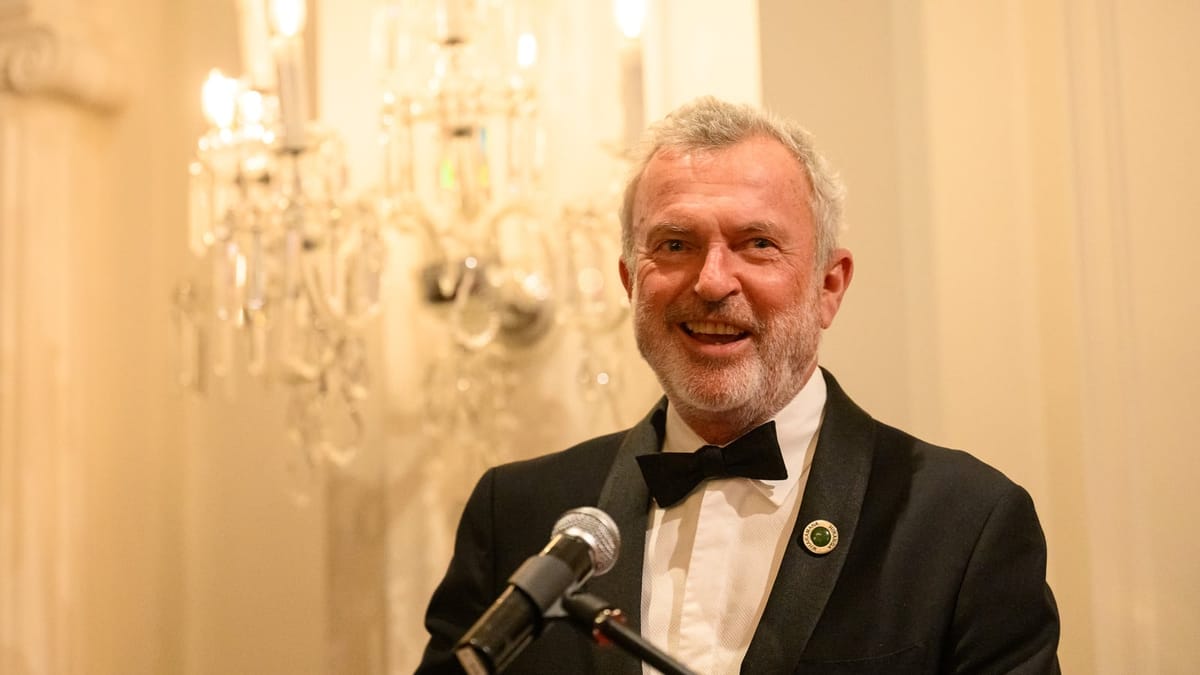
Sam Neill died on Monday 13 July 2026 in Sydney, aged 78. His family gave no cause of death, and I do not think a public life means the public is owed every private detail.
Still, the news lands.
Not in a dramatic, black-armband way. He would probably have made that feel ridiculous. It lands more like someone has quietly removed a very familiar chair from the room. You did not necessarily look at it every day, but you knew where it was.
Who was he, if you did not follow film?
For a lot of people, Sam Neill will always be Dr Alan Grant in Jurassic Park, with the hat, the children, and the velociraptors. For others he is Holly Hunter’s husband in The Piano. He was also in Possession, Reilly: Ace of Spies, Peaky Blinders, and Taika Waititi’s Hunt for the Wilderpeople.
That list tells you something. He moved between art films and blockbusters without seeming to swell up from either. He could be serious, sinister, tender, dry and very funny, often in the same face.
He was not the sort of famous person who appeared to be made of polished marble. He was known for being self-deprecating and a bit indiscreet, not grand. Online he mostly posted about his animals. There was something deeply un-Hollywood about that, even while Hollywood was very happy to use him.
The detail I keep coming back to
He was born in Omagh, Northern Ireland, on 14 September 1947. When he was seven, his family emigrated to New Zealand’s South Island.
So one of the most recognisable New Zealanders in the world started out as an immigrant child.
That matters to me, and not because it turns him into a symbol. It matters because it makes the shape of his life more interesting. He was taken to a new country young enough to grow into it, and old enough for the move to have meant something.
And once he was famous, he could have lived almost anywhere.
That is the part worth sitting with.
Why Central Otago
He chose Central Otago. Not as a postcard, and not as a brand mood. As a place with soil, frost, weather, work and names.
He founded Two Paddocks there and first released a Pinot Noir under that label in 1997. That is nearly thirty years of growing, and growing is not a glamorous verb. It means waiting, checking, losing, pruning, and trying again. It is not red carpets. It is rows.
The vineyards themselves are wonderfully specific. Gibbston, where The First Paddock is. Alexandra, with The Last Chance and Red Bank Farm. Bannockburn, with The Fusilier. Those are not vague lifestyle labels dreamed up in a marketing room. They are local, almost stubbornly so. Paddocks. Banks. A last chance.
The wine is good, too, which is not always the case when actors make it. In New Zealand Wines of the Year 2026, four of his Pinot Noirs rated between 95 and 98 points, and the Two Paddocks Pinot Noir 2023 won Red Wine of the Year.
It does not read like a hobby with better labels. It reads like a man planting himself, quite literally, in a place.
The hard years, carried lightly
In 2023 he said he had been diagnosed with angioimmunoblastic T-cell lymphoma, a rare non-Hodgkin lymphoma. In April this year he said he was cancer free.
Those are the facts, and they are enough.
Around that time came his memoir, Did I Ever Tell You This?, written in a burst in 2022. It is as much about his life outside film, especially Central Otago, as it is about acting. That feels right. Not because the acting was unimportant, but because nobody is only the work the rest of us can name.
Even in the serious years, the public version of him kept that dry, unbuttoned quality. Films behind him, animals around him, vines in the ground, and a willingness to say slightly too much now and then.
I like that combination.
What it means to choose a place
People deciding whether to leave their country get sold a shiny version of this. Follow your dreams. Start again. Become someone new.
I have never liked that language. It is too neat, and moving countries is not neat. It can be brave, and it can also be slow, lonely, expensive and full of admin. Some days it is school lunches and damp shoes. Some days it is the silence where your old language used to be. I have written before about what that first stretch actually feels like, in Fruzsi and János’s first two years here.
What his life shows, quietly, is not that moving fixes everything.
It shows that you can arrive from somewhere else and stop treating the new country as a waiting room. You can make it yours in a specific way. Not New Zealand in general, which is a tourism poster and not a life. Gibbston. Alexandra. Bannockburn. One paddock, then another. If you want the unglamorous version of what living here is actually like, I wrote that too, in what New Zealand is really like to live in.
He died in Sydney, across the Tasman. Born in Northern Ireland, raised into New Zealand, planted in Central Otago, and leaving from Australia. A life with its own geography.
And somewhere in that geography, the vines are still in the ground.
Suzanne